
Industrial engineers make complex systems work better
Would a change to traffic signal patterns reduce gridlock or prevent accidents at key intersections in Toronto? How can we deploy AI and machine learning to smooth out airline schedules or shrink the waiting list for knee replacements? In sports, can we extract data from past games to predict the best time to deploy our star player?
Industrial engineers address all these challenges and more. They leverage mathematical and computer models, including AI and machine learning and the study of human behaviour to identify changes that could make a huge difference. Whether it’s managing a global supply chain for next-generation vehicle manufacturing, scheduling surgeries in a regional hospital network or optimizing energy distribution within a power grid, industrial engineers analyze data and use their expertise to prevent errors, enhance efficiency and improve outcomes for everyone.
You will begin the industrial engineering program by learning the foundations: operations research, programming and human-centered design. In your upper years, you’ll take courses ranging from engineering psychology to data science to business process engineering, and you’ll build and deploy the latest models from the world of AI, optimization and machine learning.
Graduates of this program are in high demand for their ability to see the big picture, analyze the complex systems that underpin our daily lives and identify the tweaks that could make them safer, more efficient, and more profitable. These capabilities are needed across every sector, giving you versatile career options.
Areas of Focus
- Applied Artificial Intelligence & Machine Learning
- Logistics & Supply Chain Management
- Human Factors & User Experience
- Data Mining & Analytics
Sample PEY Co-op Employers
eBay
Environment Canada
Ernst & Young
Royal Bank of Canada
Walmart
Sample Career Trajectories
Big Data Analytics
Health-care Engineering
Financial Analysis and Planning
Management Consulting
Project Management
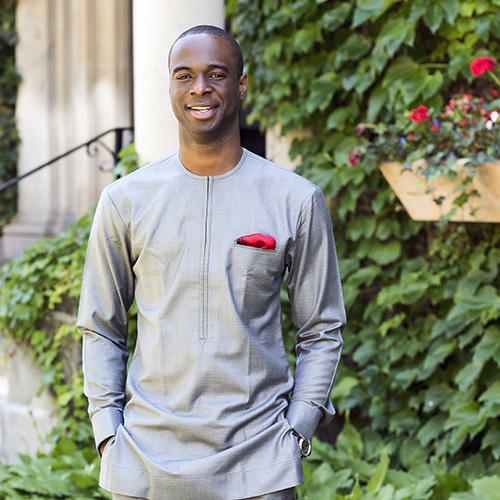
INDUSTRIAL ENGINEERING ALUMNI PROFILE
Oghosa Igbinakenzua
Graduation Year:
2018
PEY Co-op:
He landed a job in Toronto with Deloitte, a financial services and management consulting firm.
Memorable Experience:
For his fourth-year capstone project, Oghosa worked with his team, supervisor and client to create a website called Newvella. The site leverages AI and machine learning to provide readers with personalized book recommendations based on their tastes.
Fun Fact:
He was involved in several clubs and groups as a student, including serving as Vice-President Academic for the Engineering Society (student government), a soccer club and Engineers Without Borders. After graduation, he went on to become the President of Toronto’s professional chapter of Engineers Without Borders.
Current Job:
Oghosa works as a Senior Consultant at Deloitte.
“Several of my courses helped me understand how businesses operate and how to identify areas to improve efficiency. My co-curricular involvement showed me that with the support of others, I have the ability to make significant and positive change within my environment.”
Industrial Engineering First-year Courses
Fall Term
(common to all Core 8 programs)
- Orientation to Engineering
- Engineering Strategies & Practice I
- Mechanics
- Engineering Chemistry & Materials Science
- Linear Algebra
- Calculus I
Winter Term
- Engineering Strategies & Practice II
- Fundamentals of Computer Programming
- Calculus II
- Dynamics
- Electrical Fundamentals
- Intro to Mechanical & Industrial Engineering
Did you know?
Industrial engineering is closely tied to business and health care. U of T’s connections to Toronto’s financial district and hospitals give you a significant career advantage.